

Block Bloom: Color Blast
Nebula Studio
I like puzzle games that are easy to understand but still give me a reason to think before every move. Block Bloom: Color Blast fits that mood well. It is a free color block puzzle game from Nebula Studio, built around placing pieces, completing lines, and enjoying the satisfying clear that follows. The idea is familiar, but the appeal comes from how quickly a quiet five-minute session can turn into a careful exercise in space management.
After spending time with it, I see the game as a good choice for relaxed play rather than a dramatic, story-driven experience. There is no need to learn a complicated control scheme or study a long tutorial before starting. You look at the available blocks, decide where they can do the most good, and try to keep the board usable for the next turn. That simplicity makes it approachable, while the limited space creates enough pressure to keep experienced puzzle players interested.
The game belongs to the puzzle category and is suitable for Everyone. It is currently free, which makes it easy to try without treating the first session as a commitment. Its current version is 1.0.5, and it supports devices running Android 7.1 or later. Those details matter mainly because this is the kind of title I would install for short, casual sessions on a device that may not be new.
How I play Block Bloom when I want a calm but thoughtful session
My usual workflow begins with a pause rather than an immediate placement. The temptation in a block game is to fit the first piece into the most obvious empty area, but that can create awkward gaps quickly. I first look at the complete set of pieces currently available, identify the one that has the fewest practical homes, and place that piece before dealing with the more flexible shapes.
That small habit changes the feel of the game. A long piece, a corner-shaped piece, or a bulky arrangement can become difficult to use if I fill the open lanes too early. By handling the least flexible block first, I preserve more options for the pieces that can fit into several locations. It is not a flashy trick, but it prevents many avoidable mistakes.
Related News






The central rhythm is straightforward: place blocks, complete horizontal or vertical lines, and use the cleared space to continue. The most satisfying moves are not always the largest-looking ones. Sometimes a modest line clear is better than a tempting setup that leaves the board divided into disconnected pockets. I have learned to value an open, adaptable board over a single impressive placement.
That makes the game work well in an everyday situation. If I have a short break while waiting for an appointment, I can start a session without remembering a plot or rebuilding a complicated strategy. If I am tired in the evening, the familiar rules let me relax, but the board still asks me to make meaningful decisions. The game is especially comfortable when I want something more engaging than scrolling but less demanding than a competitive action title.
One useful way to think about each turn is to separate immediate gain from future safety. Clearing a line feels productive, yet a clear that removes the only useful support beneath another area can leave the remaining board harder to manage. I try to ask two questions: does this move create space now, and does it leave at least one broad area for the next awkward piece? That second question is where many of my better runs come from.
Gallery
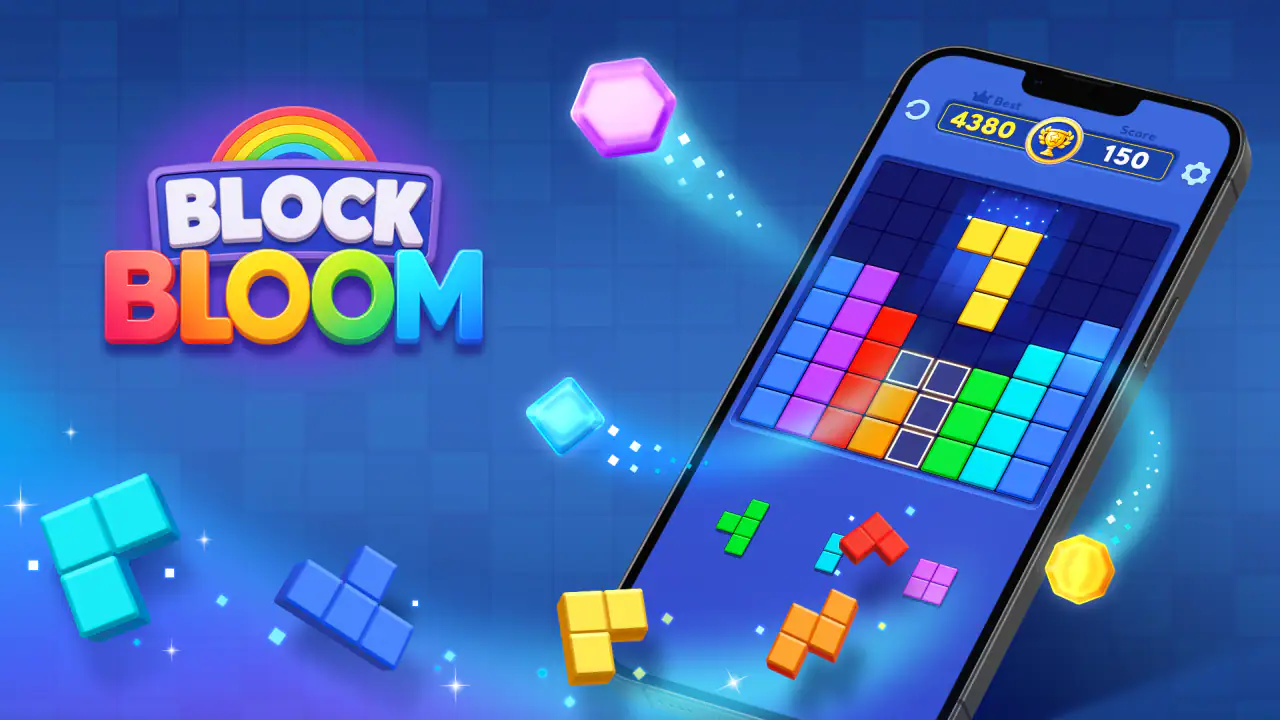
The calming presentation implied by the color-focused design suits this approach. I do not play it for a narrative, character collection, or elaborate progression system. I play it for the compact loop of observing, placing, clearing, and adjusting. Anyone looking for a puzzle that can be understood almost immediately will feel at home here.
Settings and habits that are actually worth checking
I would not approach Block Bloom expecting a deep settings menu or a long list of customization options. Its strength is the directness of the board, so I keep my attention on the controls and presentation that are visibly available rather than searching for elaborate hidden systems. Before settling into regular play, I check whether the sound and visual feedback suit the situation. For a quiet public place, I prefer a restrained setup; at home, the game’s feedback can make line clears feel more rewarding.
This is also a game where device comfort matters more than players may expect. Because the board depends on accurate placement, I play with the phone held steadily instead of trying to operate it one-handed while walking. A rushed tap can put an otherwise useful piece in the wrong position, and the mistake comes from handling rather than strategy. A stable grip and a clean screen are simple improvements that make the experience feel more precise.
I also recommend checking the game after installation rather than assuming every phone will feel identical. The minimum operating system is Android 7.1, so the title is accessible to older compatible devices, but screen size and touch response can still affect comfort. On a smaller display, I take an extra moment before confirming a placement. On a larger screen, I find it easier to scan the whole board and compare several possible locations.
Another practical habit is to decide in advance whether the session is for relaxation or for a serious personal best. When I play casually, I accept a safe move even if it does not maximize the immediate clear. When I play more carefully, I protect open lanes and avoid spending useful space simply to remove one line. Mixing those two approaches without noticing can make the game feel inconsistent, when the real issue is that I changed goals halfway through.
The game’s free price is helpful here because I can test that routine without a financial barrier. It has attracted over a hundred thousand installs and holds a 4.9 average from around eleven thousand ratings, which suggests that its simple format has connected with many players. I still treat those figures as a sign of broad appeal rather than proof that every player will enjoy it. People who dislike repetitive board puzzles will not suddenly find a story or action layer waiting underneath.
Faster patterns that improve decisions without rushing
Playing faster does not mean tapping quickly. It means reducing the number of choices I need to reconsider. My first improvement was to divide the board mentally into working zones. I keep one area relatively open for large or awkward pieces, use another area for building lines, and avoid scattering isolated blocks across the entire board. This gives each new piece a likely destination before I even start comparing exact placements.
I also look for near-complete lines that can be finished without damaging the rest of the board. A nearly full row is attractive, but it should not automatically receive the next piece. If completing it forces a large block into a narrow corner, the clear may be less valuable than preserving a flexible central space. The best fast decisions are usually the ones that solve a current problem while keeping two or three future options alive.
Corner placement is another area where restraint helps. Corners can be useful for shapes that naturally fit against an edge, but filling them with a piece that could work elsewhere may remove an important escape route. I use corners when the shape benefits from them, not simply because they look tidy. This is particularly useful when the board begins to develop uneven edges and the open middle becomes the only area capable of accepting a broad piece.
When several pieces are available, I rank them by risk rather than by size. A small piece can be surprisingly restrictive if it only completes one narrow gap, while a larger piece may have several natural positions. I usually place the piece with the smallest number of safe locations first, then reassess the board. This repeatable order is more reliable than chasing the biggest immediate clear.
There is also a useful distinction between creating a hole and creating a pocket. A hole is an empty space that can still be reached by an appropriate piece. A pocket is an empty space surrounded by blocks in a way that makes it effectively useless. I try to avoid building pockets, even when doing so would complete a line, because dead spaces consume the board without contributing to future clears.
For a quick session, I use a simple three-step loop. I scan all current pieces, identify the most restrictive one, and place it where it preserves the broadest remaining area. Then I check whether the next piece can complete a line without sealing off that area. Finally, I reassess instead of following the plan automatically. The board changes after every clear, so a rigid sequence is less helpful than a consistent decision process.
These habits are more valuable than trying to play at frantic speed. They reduce careless placements and make the game feel smoother. They also explain why the title can appeal to both beginners and experienced puzzle players: the rules stay simple, but the quality of a move depends on how well I manage future possibilities.
Where the strategy reaches its limits
Block Bloom is relaxing, but it is not effortless. The same randomness or piece availability that keeps each board uncertain can also create situations where my preferred plan is no longer practical. I cannot always preserve a perfect open zone, and sometimes the pieces force a compromise. The right response is to adapt early instead of protecting an old plan after the board has already changed.
One limitation is that this style of game can become repetitive for players who need constant novelty. The satisfaction comes from improving placement decisions and extending a run, not from unlocking a series of different activities. If you want a puzzle game with a campaign, characters, narrative objectives, or a large variety of distinct modes, a more feature-heavy alternative may suit you better.
It is also not the best option when I want direct competition. The experience is personal and board-focused, so it does not replace a multiplayer puzzle game built around live opponents, rankings, or timed matches. I prefer Block Bloom when I want control over my pace. Someone who needs social pressure or visible competition may find the calm format too solitary.
Another trade-off is the balance between relaxation and concentration. The game is easy to start, but a strong run requires attention. If I am distracted by a conversation or trying to play while moving around, I make poor placements. For that reason, I would not describe it as a mindless background activity. It is casual in its rules, but not always casual in the attention it rewards.
The age rating of Everyone makes it broadly approachable, and the uncomplicated premise is suitable for a wide range of players. Still, younger players may benefit from learning the difference between an immediate clear and a safe long-term placement. The game can teach useful spatial habits, but it does not automatically explain why one move is stronger than another. I found that improvement came from observing the board after mistakes rather than simply replaying the same impulse.
Compared with match-three puzzles, this game gives me more control over the pieces I place but less emphasis on chain reactions and special combinations. Compared with classic falling-block games, it is less about reacting under a timer and more about planning in open space. Compared with minimalist number puzzles, its decisions are visual and spatial rather than based mainly on arithmetic or merging values. Those differences make it a good middle ground for players who want deliberate thinking without a heavy ruleset.
I would skip it if my main requirement were a substantial progression system or a constantly changing set of challenges. I would also look elsewhere if I wanted a game that rewards rapid reflexes more than careful board reading. But if the goal is a free, approachable puzzle that can fill a short break and still reward better habits over time, its limitations are fairly easy to accept.
Who gets the most from this particular puzzle
I think Block Bloom is strongest for people who enjoy organizing space. It suits players who like looking several moves ahead, protecting useful gaps, and finding a clean solution from an imperfect position. It is also a good fit for anyone who wants a game that can be played in short bursts without requiring a large commitment before the first meaningful decision.
It works for a commuter waiting on a platform, a student taking a brief mental break, or someone winding down before sleep. In each case, the key benefit is that the game starts quickly and does not demand a complicated setup. I can play with a relaxed pace, stop thinking about it for a while, and return to the same basic style of decision-making without having to relearn a system.
Experienced players can make the sessions more interesting by treating the board as a resource rather than a collection of empty squares. I watch the shape of the remaining open area, avoid creating unusable pockets, and prioritize pieces with fewer safe placements. Those techniques do not require invented shortcuts or hidden mechanics; they come directly from using the available pieces more deliberately.
New players should not worry about chasing perfect moves immediately. A better starting goal is to notice what caused a board to become cramped. Was a corner filled too early? Did a line clear remove a useful support? Was a flexible piece used in the only area that could accept a difficult shape? Answering those questions turns each failed run into practical feedback.
The developer, Nebula Studio, has kept the concept focused. That focus is a strength because the game’s identity is clear from the first session. It is also the reason some players may eventually want more variety. I appreciate that the title does not pretend to be a different kind of game; it offers a compact block puzzle and asks whether that loop is enough for me.
My verdict after settling into its rhythm
Block Bloom: Color Blast is an easy recommendation for a specific kind of player: someone who wants a calm, free puzzle with simple rules and room for thoughtful improvement. The line-clearing loop is familiar, but the game becomes more rewarding when I stop treating each piece as an isolated opportunity and start protecting the board I will need several moves later.
Its strongest quality is accessibility without complete shallowness. I can hand it to a new player and explain the basic idea in moments, yet I can still improve my results by changing how I rank pieces, use corners, and preserve open zones. That is a good balance for a casual puzzle game.
The limitations are clear as well. It will not satisfy someone searching for a story, a large collection of modes, live competition, or constant visual change. Its appeal depends on enjoying repetition with refinement. If that sounds boring, the polished simplicity will not change your mind. If it sounds comfortable, the game has enough strategic texture to keep short sessions from feeling empty.
With a 4.9 average from roughly eleven thousand ratings and more than a hundred thousand installs, it has already found a sizeable audience. I would not use popularity alone to choose a puzzle, but those figures match my impression that the format is immediately approachable. The Everyone rating and support for Android 7.1 or later make it an especially uncomplicated option to try on a broad range of compatible phones.
My practical advice is to play for board quality, not just for the next clear. Place restrictive pieces first, keep at least one broad area open, treat corners as tools rather than storage, and pause whenever a move looks attractive only because it clears a line. That approach makes the game calmer, improves consistency, and reveals the small strategic decisions beneath its colorful surface.
For me, that is where the title succeeds. It does not need a complicated presentation to make a break feel worthwhile. It gives me a board, a few choices, and just enough uncertainty to make careful placement matter. If you want a straightforward color block puzzle for relaxed sessions with a little genuine planning, Block Bloom: Color Blast is worth trying. If you need deep variety or competitive energy, choose a different puzzle style instead.
FAQs for Block Bloom: Color Blast
What is Block Bloom: Color Blast, and how is it played?
Block Bloom: Color Blast is a casual block puzzle game centered on placing colorful shapes onto a board and clearing completed lines or matching arrangements. The controls are generally simple: choose a piece, position it in an available space, and plan your next moves before the board becomes crowded. Its relaxing presentation makes it accessible, while later situations can require more careful planning.
Is Block Bloom: Color Blast free to download and play?
The game can typically be downloaded without an upfront purchase, allowing you to try the main puzzle experience for free. However, free mobile games may include advertising, optional in-app purchases, or both. These extras can be used to remove ads, obtain additional assistance, or access certain conveniences. Check the current Google Play or App Store listing for exact pricing and purchase details.
Does Block Bloom: Color Blast work offline?
Many block puzzle sessions can usually be played without a continuous internet connection, which makes the game suitable for short breaks, travel, or areas with weak reception. Nevertheless, some features may still require internet access, including advertisements, purchases, cloud services, updates, or online events. For the most reliable information, test the game after temporarily disabling mobile data and Wi-Fi.
Is Block Bloom: Color Blast suitable for children and casual players?
The straightforward drag-and-place gameplay is generally suitable for casual players and beginners, since it does not require complicated controls or fast reactions. Parents should still review the age rating, advertising practices, and in-app purchase settings before allowing children to play. If the game displays ads or offers purchases, enabling device-level parental controls is a sensible precaution.
Are there any important drawbacks to consider before downloading?
The main concerns depend on your preferences. Players who enjoy competitive action, story content, or constantly changing mechanics may find a block puzzle format repetitive after extended sessions. Advertisements can also interrupt the experience in free versions, and optional purchases may not appeal to everyone. Before installing, review the latest permissions, privacy information, ratings, and user comments for your device.
Pros
- Simple tap-to-match gameplay is easy to learn and play in short sessions.
- Bright visuals make the colored blocks easy to distinguish.
- Increasing difficulty keeps later levels engaging.
- Offline play is convenient when no internet connection is available.
- Relaxing sound effects complement the casual puzzle experience.
Cons
- Some levels may feel repetitive after extended play.
- Limited strategic depth may not satisfy experienced puzzle fans.
- Progress can become slower as the difficulty increases.
- Small screens can make similarly colored blocks harder to compare.
- Optional ads may interrupt the flow between levels.


